
Windows 11 has an "Extend Volume" function in its native Disk Management tool, but many people find they cannot extend a partition with it, even after shrinking or deleting another volume. This is frustrating when you urgently need to extend system partition C because it is running out of space. This article explains why you cannot extend volume in Windows 11 with Disk Management, and what to do when you are unable to extend a partition in a Windows 11 laptop, desktop, or tablet.
The Reasons Why Cannot Extend Volume in Windows 11
1. No Adjacent Unallocated Space on the Right
To extend a partition in Windows 11 using the Disk Management "Extend Volume" function, there must be contiguous Unallocated space on its right side. Otherwise, the Extend Volume option is grayed out.
Alongside Extend Volume, there is a "Shrink Volume" function to help resize partitions. However, this function can only make Unallocated space on the right side when shrinking a partition.
For example, after shrinking the D: drive with Disk Management, Unallocated space is generated on the right of D. This Unallocated space cannot be extended to the C: or E: drive because it is non-adjacent to the C drive and is on the left of the E drive.

2. Different Partition Type
Because Disk Management cannot extend a partition with non-adjacent Unallocated space, some people try to delete the adjacent partition D. However, they still cannot extend the C drive after that.
On an MBR disk, the partitions to be deleted and extended must be the same type (both Primary or both Logical). Otherwise, you cannot extend the volume in Windows 11 with Disk Management even after deleting.
- All partitions are Primary on a GPT disk, so few Windows 11 users will encounter this issue.
- Do not delete a partition if you installed programs in it or if you cannot back up your files first.

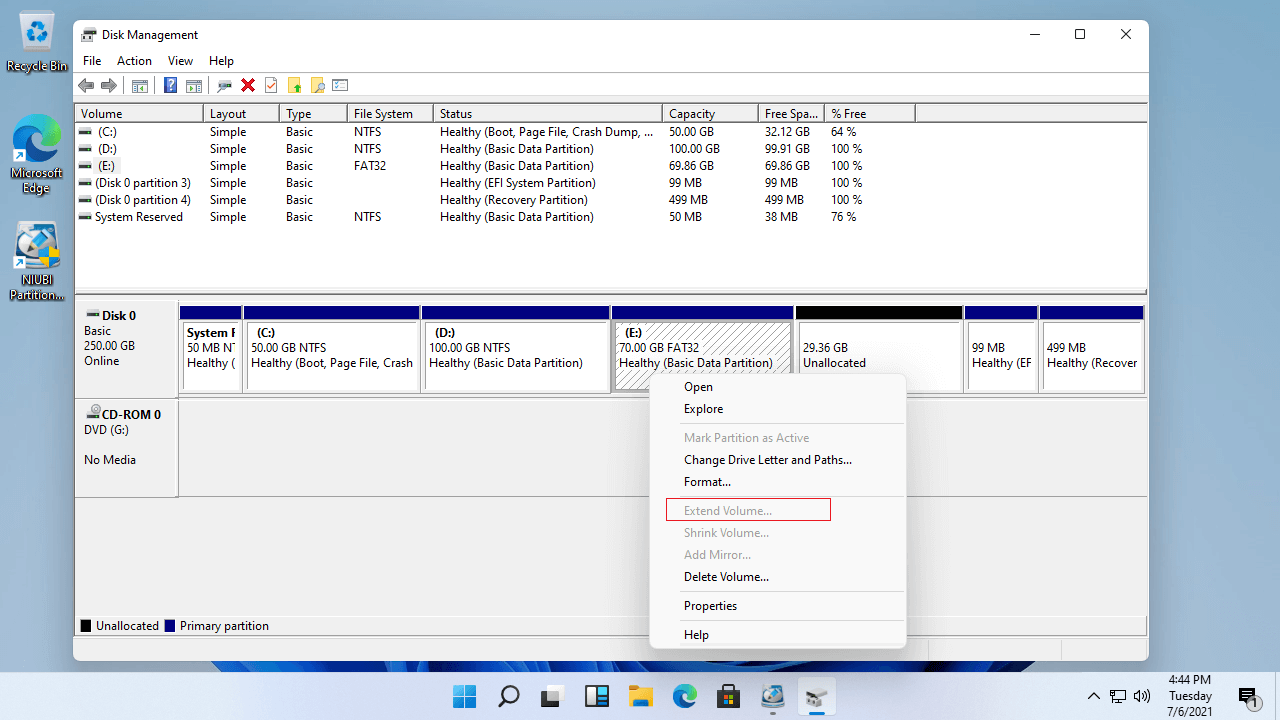
3. Only NTFS Partition Is Supported
As the screenshot shows, the Extend Volume option is greyed out for the E drive because it is formatted with FAT32.
4. Windows 11 Cannot Extend EFI/Recovery Partitions
You cannot extend an EFI or Recovery partition in Windows 11 Disk Management, even if there is adjacent Unallocated space on the right. Only third-party software can help you.
5. 2TB Restriction on MBR Disks
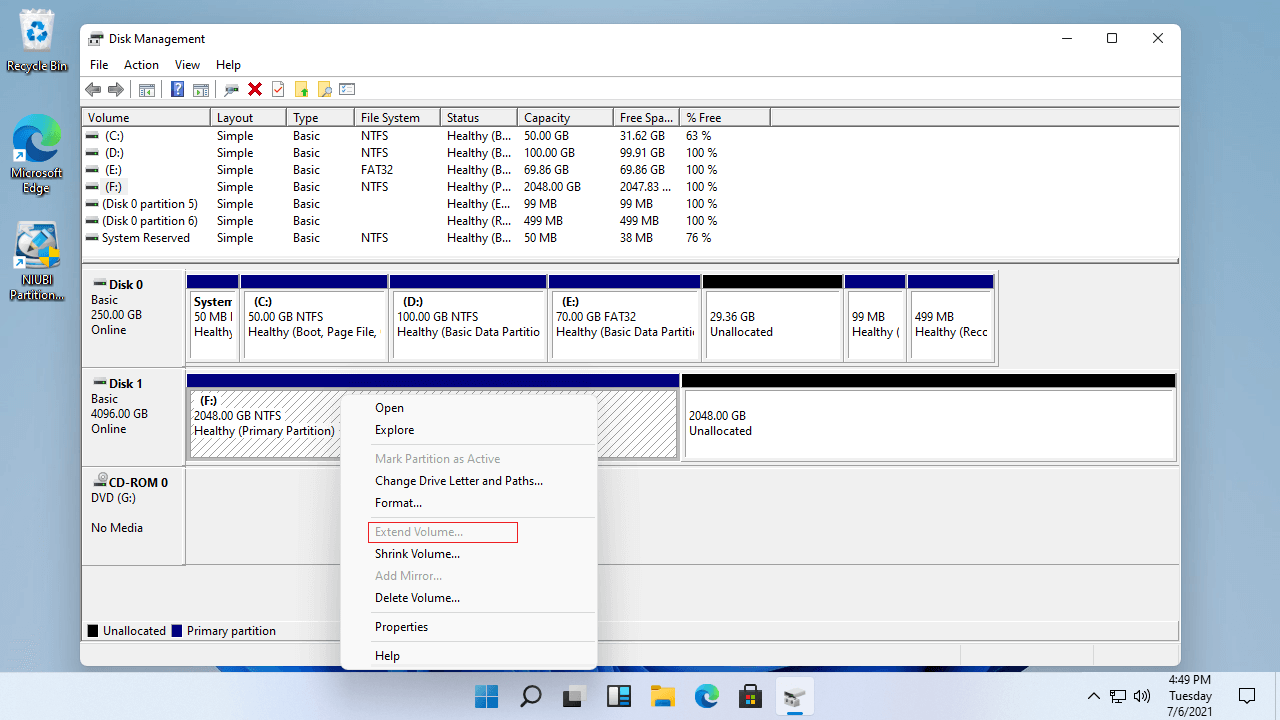
In Windows computers, there are two common types of disks: MBR and GPT. The maximum usable space on an MBR disk is 2TB. If your disk is MBR style, you cannot extend a partition past 2TB in your Windows 11 computer.
Why Cannot Extend Partition in Windows 11 With DiskPart CMD
Like previous versions, Windows 11 has a "diskpart" command prompt tool to help manage disk partitions. Although the method to shrink and extend partitions is different, the diskpart command has the same limitations as Disk Management when resizing partitions. If you are unable to extend a volume in Windows 11 with diskpart, follow the same solutions below.
What to Do When You Are Unable to Extend Volume in Windows 11
There are several methods when you cannot extend a volume in a Windows 11 desktop, laptop, or tablet. Select the corresponding method according to your own disk partition configuration.
Method 1 - Move Partition and Unallocated Space
If you have shrunk a partition (such as D:) and got Unallocated space, you cannot extend partition C with this non-adjacent Unallocated space. In this situation, run NIUBI Partition Editor to move the D: drive rightward, then the Unallocated space will be adjacent to the C drive.
Steps when you cannot extend volume C in Windows 11 after shrinking D:
- Download and launch NIUBI Partition Editor. Right-click the D: drive and select "Resize/Move Volume". Drag the middle of the D drive rightward in the pop-up window. Then, this partition will be moved to the right, and the Unallocated space will be moved to the left.
- Right-click the C: drive and select "Resize/Move Volume" again. Drag the right border rightward to combine this adjacent Unallocated space.
- Click Apply on the top left to take effect.
Watch the video to see how to operate:
If there is a Recovery or other small partition between C and D, you should continue to move this partition to the right until the Unallocated space is next to the C drive.
Method 2 - Shrink and Extend Partition with NIUBI
Windows 11 Disk Management cannot extend a partition into Unallocated space on the left. If you have shrunk the D drive and want to extend partition E, right-click E: in NIUBI Partition Editor and select "Resize/Move Volume". Drag the left border leftward to combine the contiguous Unallocated space.
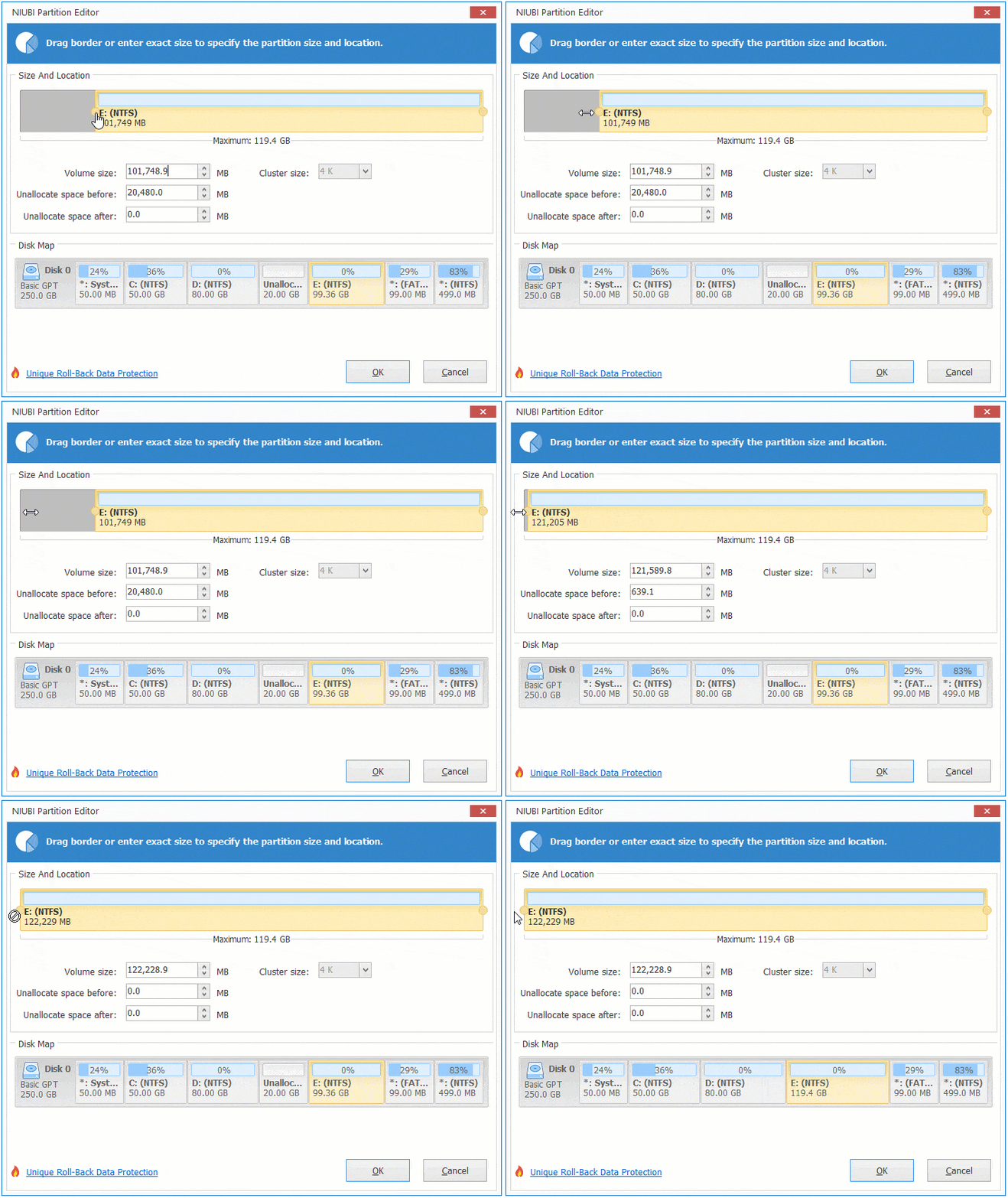
Watch the video to see how to extend an EFI/Recovery partition. For NIUBI Partition Editor, there is no difference whether you resize NTFS or FAT32 partitions, or resize Primary or Logical drives.
Method 3 - Convert Disk From MBR to GPT
Windows 11 cannot extend a volume larger than 2TB on an MBR disk. To do that, you must convert MBR to GPT in advance.
In Summary
When you are unable to extend a partition in a Windows 11 laptop, desktop, or tablet, open Disk Management and check the disk partition configuration in your computer. Find out the associated reason and follow the corresponding method above. Besides shrinking, moving, and extending partitions, NIUBI Partition Editor helps you perform many other disk partition management operations.
 © 2009 - NIUBI Technology All Rights Reserved. |